Branding
How to Incorporate in Wyoming (2025) Cheapest & Fastest Options

Incorporation is not a bureaucratic checkbox. It is a foundational maneuver in your IP architecture. For the sophisticated founder, the choice of jurisdiction is the first real test of strategic foresight. You are not just starting a business. You are engineering a vehicle for capital efficiency.
Wyoming has long been the quiet favorite for those who value structural integrity over coastal vanity. It offers a lean, high-performance legal framework that prioritizes the two things a serious executive cares about: privacy and the bottom line. Most amateurs flock to Delaware because they heard it in a podcast. They end up paying for the privilege of being part of a crowded, expensive docket.
The smart money looks at unit economics. Wyoming delivers a superior "Legitimacy Stack" for a fraction of the overhead. When you combine this jurisdictional leanness with a .inc domain, you aren't just filing papers. You are signaling to the market that your entity is built for institutional-grade scaling.
Privacy as a Defensible Moat
In an era of hyper-transparency, privacy is a luxury asset. Wyoming understands this better than any other state. They do not require the disclosure of managers or members in public filings. This is not about hiding. It is about controlling the narrative of your cap table.
Founder anonymity is a strategic shield. It prevents frivolous litigation from fishing for deep pockets before you even clear Seed or Series A. In states like California, your personal information is essentially public record from day one. In Wyoming, your entity is a black box.
One founder we interviewed, a former Senior VP at a Tier-1 fintech firm, noted that the Wyoming blind filing was the only reason they were able to quietly develop their stealth-mode IP without tipping off former competitors. The moment they secured their .inc domain and their Wyoming LLC, the perimeter was set. They owned their identity without exposing their flank.
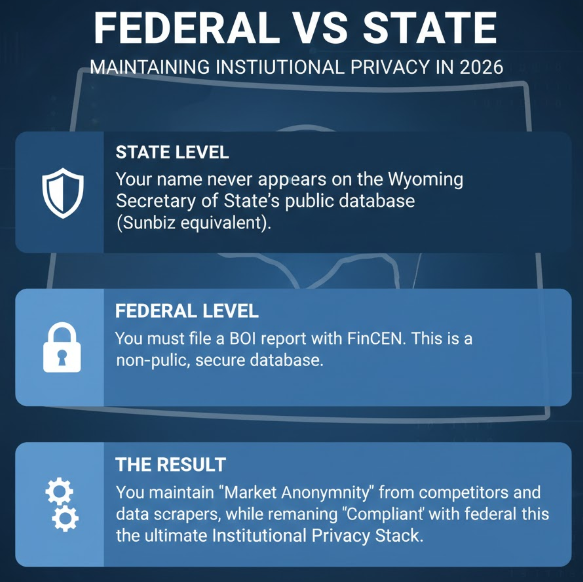
Federal vs. State:
While Wyoming remains the premier "Anonymous LLC" jurisdiction at the state level, founders must navigate the federal Beneficial Ownership Information (BOI) requirements.
- State Level: Your name never appears on the Wyoming Secretary of State’s public database (Sunbiz equivalent).
- Federal Level: You must file a BOI report with FinCEN. This is a non-public, secure database.
- The Result: You maintain "Market Anonymity" from competitors and data scrapers, while remaining "Compliant" with federal law. This is the ultimate Institutional Privacy Stack.
Optimizing the Balance Sheet: Zero-Tax Architecture
Let's discuss the math. Wyoming has no corporate income tax. No personal income tax. No franchise tax. For a founder focused on extending runway, these are the only metrics that matter. Every dollar saved on state-level friction is a dollar reinvested into your R&D or CAC.
Amateurs mistake cheap for low quality. In the legal world, Wyoming is the opposite. It is high-efficiency. The state’s legal system is sophisticated, with a long history of case law that protects the charging order status of LLCs. This means a creditor cannot simply seize your business assets to satisfy a personal debt. They are limited to distributions, which you, as the manager, control.
This level of asset protection is a prerequisite for anyone managing significant personal or institutional wealth. When you frame your company under a .inc extension, you are wrapping this legal protection in a global brand signal. You are telling your investors that you have optimized for every possible risk vector. To verify these advantages, founders should consult the Wyoming Secretary of State (External) for direct access to official fee schedules and filing requirements.
Avoiding the Cutesy Branding Trap
Your domain is your digital real estate. It is the most visible asset on your balance sheet. Yet, many founders sabotage their Wyoming-based privacy and tax advantages by choosing a cutesy or misspelled TLD. Using a .co, .io, or a hyphenated mess is an amateur move. It smells of early-stage desperation.
A .inc domain is the only extension that carries the weight of a legal ending. It is a universal signifier of a formed, serious entity. When an M7-trained VC looks at your pitch deck, Company.inc registers as an institution. CompanyApp.net registers as a hobby.
"We wasted six months explaining why we chose a boutique TLD," says Sarah J., a founder who recently transitioned her Wyoming-based AI startup to a .inc. "The moment we made the switch, the legitimacy conversation ended. The domain did the work for us. It converted brand education time into transaction time." You can explore how this transition works in our guide on Brand Protection (Internal)..
The Wyoming-to-Global Pipeline
The process of incorporating in Wyoming is famously fast. You can be up and running in 24 hours. But the speed is a trap if you haven't secured your digital headquarters. The smartest founders synchronize their Wyoming filing with their .inc acquisition.
By securing the .inc version of your legal entity name, you create a 1:1 match between your USPTO (External) filings, your Secretary of State records, and your digital presence. This is IP Architecture in its purest form. It eliminates confusion. It hardens your trademark claims. It makes your eventual exit or IPO significantly cleaner during the due diligence phase.
Legal experts from top-tier firms specializing in venture formation often cite the Clean Entity rule. A Wyoming entity paired with a matching .inc domain is the gold standard for a clean audit trail. It shows that the founders understood the value of their brand equity from the moment of inception. Detailed breakdowns of these costs can be found in our Incorporate in Wyoming (Internal) resource.
Execution: The Only Metric That Matters
You have two paths. You can follow the herd into high-tax, high-disclosure jurisdictions and hope for the best. Or, you can execute a Wyoming arbitrage. You can build a fortress of privacy and tax efficiency while projecting institutional scale through your domain choice.
The cost of a .inc domain is a rounding error compared to the value of the trust it generates. It is a one-time capital expenditure that pays dividends in every email sent and every contract signed. In the world of high-stakes technology and finance, you do not get points for being creative with your corporate structure. You get points for being defensible.
Owning your .inc is the logical next step for any entity that intends to survive the next decade. It is the digital equivalent of a marble lobby in a Manhattan skyscraper. It says you are here. It says you are real. It says you are incorporated. To understand the broader economic context of state-level competition, refer to the Tax Foundation (External) for their latest business climate rankings.
Claiming Your Institutional Identity
The window for securing premium digital real estate is closing as more institutional players recognize the value of the .inc asset class. This is not a purchase for the faint of heart or the vibes-based entrepreneur. This is a balance sheet decision for the executive who understands that legitimacy is earned through strategic choices.
Your Wyoming entity is the engine. Your .inc domain is the chassis. Together, they represent a vehicle capable of navigating the complexities of the global market with maximum efficiency and minimum exposure.
Stop playing at business with amateur extensions and fragile legal structures. Build your institution on solid ground.
Frequently Asked Questions (FAQ)
Q1: Can a non-U.S. resident or a non-Wyoming resident form an LLC there?
A: Yes, absolutely. Wyoming is highly welcoming to both non-U.S. residents and U.S. residents who live in other states. You do not need to be a Wyoming resident to start a business in Wyoming. The only requirement is that you must maintain a registered agent with a physical address within the state.
Q2: What is the single major advantage of Wyoming LLC formation over Delaware?
A: The primary advantage is long-term cost and privacy. Wyoming's annual maintenance fee (license tax) starts at just $60, while Delaware imposes a flat $300 annual franchise tax. Additionally, Wyoming provides superior anonymity by not listing members' names in public state filings.
Q3: How fast can I start my business in Wyoming?
A: The fastest option is filing the Articles of Organization online through the Wyoming Secretary of State. The state's standard processing time is typically 1-2 business days for online filings. Thereafter, obtaining a free EIN from the IRS is instant. You can be legally operational within 72 hours.
Q4: If I live in Texas but form an LLC in Wyoming, where do I pay my business taxes?
A: You pay taxes based on where you operate and where you live. Since neither Wyoming nor Texas has a state income tax, you will only pay federal self-employment taxes. However, you must register your Wyoming LLC as a "Foreign LLC" in Texas if you are physically conducting business there (e.g., have an office or employees), which means you must also meet Texas's compliance requirements.
My.inc helps founders, startups, and incorporated businesses establish credibility online with premium .inc domains, hassle-free setup, free custom email, and real human support. Built for brands that want to signal seriousness and permanence from day one, My.inc makes it easy to create a polished, professional online presence.