Business
The .com is taken. Here's What Founders Actually Do
.png)
Quick answer: When your .com is already registered, you have three options: buy it from the current owner, pick a different name, or register your name on another extension. Premium .com purchases can run anywhere from a few thousand to six or seven figures, so the math depends on your budget and how attached you are to the exact name. Alternative extensions vary widely in cost, credibility, and availability, and the right one depends on what you're building.
This guide walks through all three with real numbers so you can decide for yourself.
You've already been through the business name generators
By now you know the drill. You ran your idea through three different name generators. You opened twenty tabs and checked availability on every option. You said the good ones out loud, ran a few past a co-founder, maybe sketched the logo in your head.
And you finally landed on it: short, memorable, and says exactly what you do. The one. So you type it into a registrar with the giddy confidence of a founder one click from a brand:
yourbusiness.com — $40,000. Make Offer.
Or worse: a parked page from 2003 with a "Buy This Domain" link routing to a broker in Tbilisi.
This happens to nearly every founder now. The .com you wanted is either parked by a speculator, owned by a company that will never sell, or priced like a small acquisition. Everyone Googling that phrase is doing the same math you are right now: how much is this name actually worth, and what are my real options?
This piece walks you through every choice honestly. No fluff. By the end, the math does the selling.
The three choices every founder faces
When your .com is gone, you have exactly three real paths. That’s it.
1) Pay the ransom.
The secondary market for premium .com domains has moved up significantly over the past few years. What used to be a $10K conversation is now often a $40K floor, and that assumes the owner is willing to sell at all. For a company post-Series A with a brand that would cost more to rebuild than to acquire, this can make sense. The math is brutal but clean: pay once, own it forever, never think about it again.
For everyone else, the numbers rarely work. And there is a hidden cost the broker will not mention: the moment you signal interest, the price adjusts. You are not negotiating a domain. You are negotiating with someone who knows exactly how much you want the thing they have.
2) Choose to change the name.
This is the option founders almost never choose once there are customers, employees, and any brand equity at all. Pre-launch, it is the right call more often than people admit. If you have not yet put the name on anything real, the cost of changing it is a week of hard conversations. After launch, the cost compounds fast. Every month you operate under a name, the work of unmaking it gets heavier.
3) Pick an Alternative TLD
This is where 2026 looks completely different from 2015.
The TLD landscape has matured 66% of YC startups don't have the .com of their name up from near-zero a decade ago.
Founders have voted with their wallets. But not all alternative TLDs are equal. Here's the honest breakdown:
The honest comparison
Here's where the math gets interesting.
Unlike .io and .co, .inc is not tied to any country. Unlike .com, the exact-match name you want is almost certainly still available. And unlike every other alternative TLD, it signals one specific thing: this is a real company.
A few real founders using .inc today, in their own words:
"We launched our business on collabcreators.com. Then we upgraded to collab.inc which is much shorter and matches our brand exactly."
-James McFadden, Founder & Co-CEO, Collab.inc
Pricing:
Ownership of a .inc runs ~$250/year. You can also reserve your name before you’re ready to validate for $4/month (my.inc pricing). That's more than a .com renewal, less than a .com ransom by 3–4 orders of magnitude.
The one-decision framework
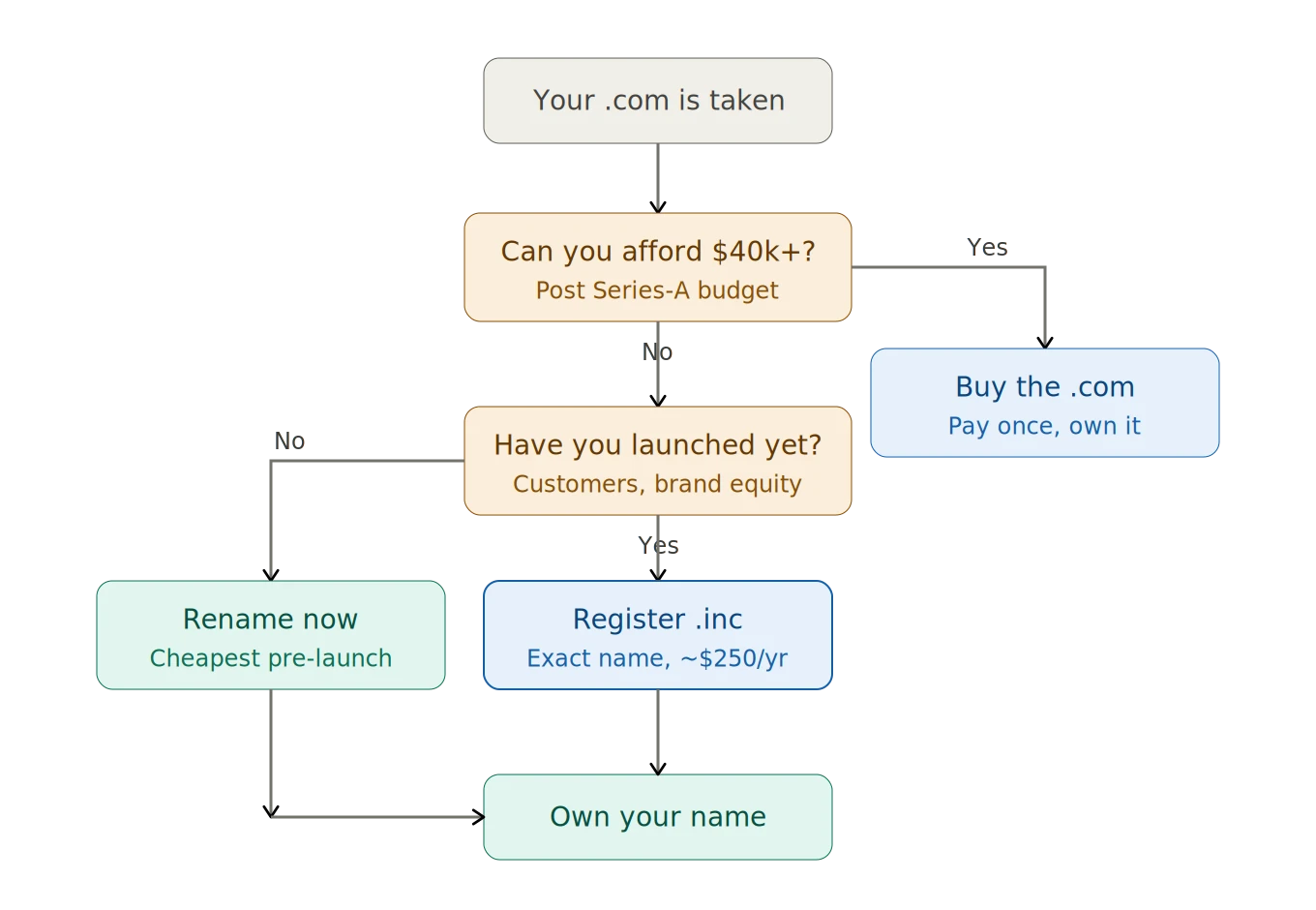
Here is the principle that makes the rest of this simple.
Your name should match your domain. Your domain should match your entity.
"Match" does not mean visually similar or technically functional. It means totally aligned. It means the extension is doing the same work as the name. It means when someone reads the full domain, they get a single, coherent signal about who you are and how seriously you take it.
.inc domain does something no other extension does: it carries the one suffix that founders already know means something. Not a tech abbreviation. Not a country code. Not a clever workaround. The suffix that incorporated companies carry. The one that has appeared after real company names on real documents for longer than the internet has existed.
When your company is called Acme, "Acme Inc." is not a domain. It is a name. The kind of name you put on a building.
So What's the Right Move?
The .com situation was never about the domain. It was the first moment you had to decide how seriously to take the name you picked. Most founders made that decision fast, under pressure, with limited options. That decision does not have to be permanent.
The company you wanted to build already has a name. The question is whether you're willing to let someone else's parked domain decide what it is.
Check if [yourname].inc is available.

Meet Vidhi Mehta, a content strategist and marketer specializing in content generation and brand building. Read her latest insights on domains, marketing, and brand growth.