Domains
The TLD Efficiency Ratio

In the ecosystem of high-growth ventures, there is a pervasive, expensive lie that founders tell themselves: "The product speaks for itself."
It doesn’t.
Before a prospective investor reads your deck, before a customer tries a demo, and before the press picks up your Series A release, they parse your URL. It only takes a split second to sort you into one of two buckets: a legitimate, institutional-grade entity, or a side project still trying to find its footing.
This isn’t about aesthetics. It’s about unit economics.
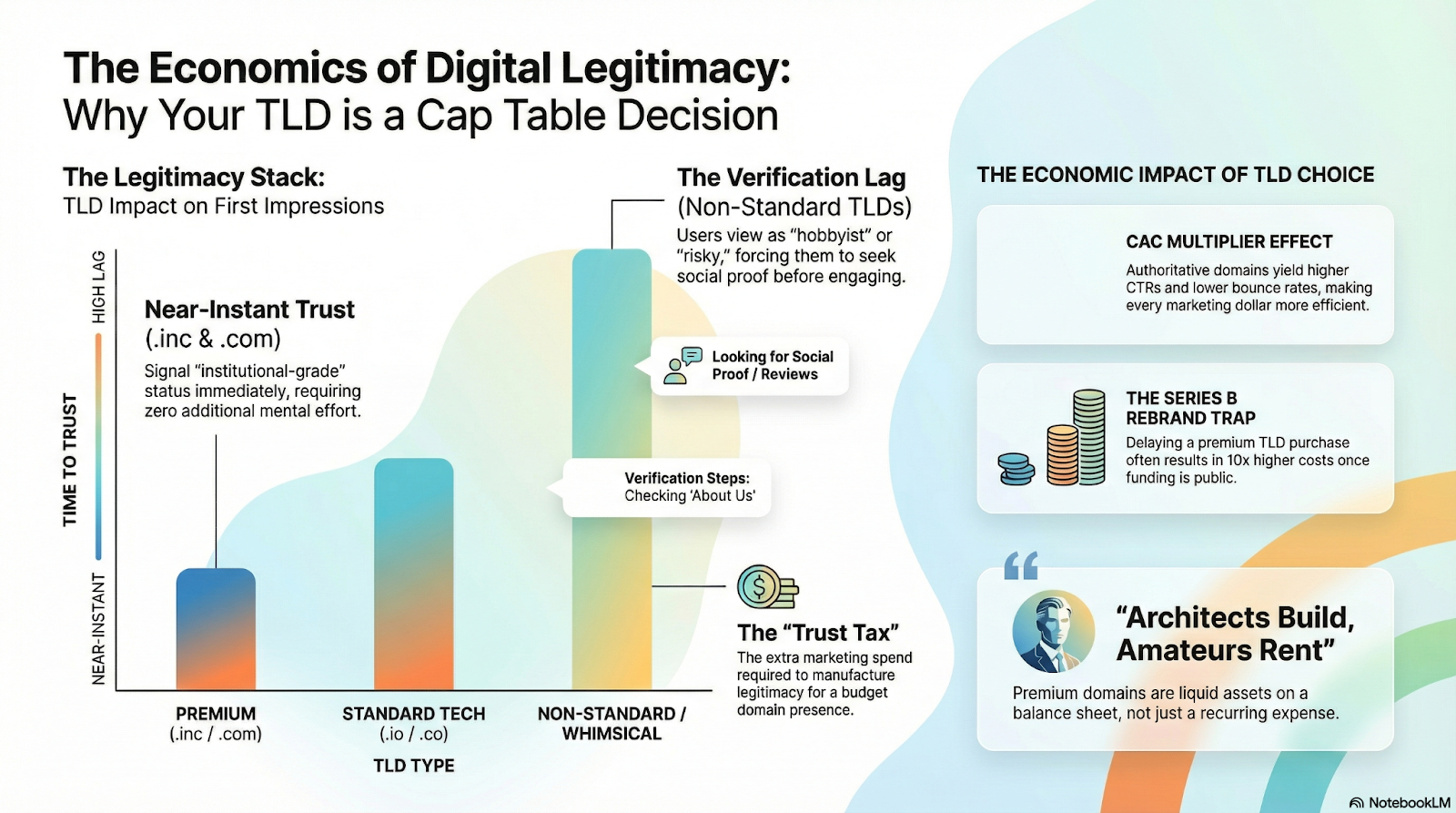
The Top-Level Domain (TLD) you choose whether it’s a.inc, or one of the many other options is a piece of digital real estate that either accelerates trust or forces your marketing budget to work overtime to manufacture it.

The Cognitive Friction of "Cute" Domains
The last decade of startup naming conventions has been defined by a wave of .io, .co, and creatively spelled names. For a time, these names were a shorthand for "scrappy tech innovator."
Now, the landscape is shifting.
For potential enterprise clients, a .io or a less common domain suffix might create a moment of hesitation. It can sometimes be associated with developer tools or smaller-scale projects. This can create an extra question in the customer's mind, a need to mentally verify the company's scale and focus. It's a subtle but important consideration in a world where first impressions matter.
Legitimacy is binary. You either have it or you don't.
Serious founders understand that cognitive load is a conversion killer. If your user has to expend mental energy decoding your URL or wondering if they typed it correctly, you have already lost brand equity.
Using a premium TLD like .inc removes that friction. It leverages the global, century-old understanding of what "Inc." means: Incorporated. Business. Liability protection. Scale. It frames your startup not as an experiment, but as an institution.
The Unit Economics of Trust
Stop thinking of your domain as a $10 expense and start treating it as part of your CAC calculation.
Every time you share a link, run an ad, or print a business card, you are paying for attention. If your domain looks "budget," it could have an impact on your click-through rate (CTR). This would cause your cost per lead to rise, effectively leading you to pay a "trust tax" on every single impression because your infrastructure looks shaky.
Consider the math of a premium TLD:
- Higher CTR: Users are more likely to click a link that looks authoritative.
- Lower Bounce Rate: Visitors arriving at a professional URL assume the content is high-value.
- Brand Recall: "Name.inc" is sticky. "Get-Name-App.io" is not.
When you purchase a .inc, you are pre-paying for legitimacy. You are front-loading the trust equation so that your marketing dollars go toward selling your product, not apologizing for your brand presence.
The "Series B Rebrand" Trap
There is a specific, painful lifecycle event that happens to startups that compromise early on their IP architecture.
It usually hits around Series B. You’ve raised $20M+; you’re scaling into enterprise sales; you’re looking at M&A opportunities. Suddenly, your "clever" domain name feels like a liability. It looks childish on a contract.
So, you try to buy the premium version.
But now, the broker knows you have funding. The price of that domain has gone from $50k to $500k. You are forced to burn equity-backed cash to fix a mistake you made at the seed stage.
Owning a .inc domain from day one is a hedge against future extortion.
It secures your exact-match brand identity immediately. No "get" prefixes. No "hq" suffixes. Just your brand, coupled with the international standard for business. It is a defensive moat around your IP.

Signal vs. Noise in a Post-ZIRP World
The zero-interest-rate policy party is over. Capital is expensive again. Due diligence is ruthless.
The era of "growth at all costs" tourist founders is being flushed out; the era of durable, efficient operators is here. Investors and enterprise partners are desperately scanning the horizon for signals of maturity. They need proof you understand the mechanics of building an institutional entity, not just a pitch deck.
An .inc domain acts as a subtle but powerful dog whistle to sophisticated capital. It communicates three things instantly:
- We Capitalize Assets: We don't cut corners on foundational infrastructure.
- We Are Durable: We differ from the noise of disposable, flavor-of-the-month apps.
- We Are Global: "Inc." is recognized internationally as the standard for business.
In a sea of startups clamoring for attention with noisy branding, the .inc domain stands still. It projects the kind of quiet authority that greases the wheels of serious valuation discussions.
The Balance Sheet Imperative
Shift your perspective from marketing expense to capital expenditure. Talk to your CFO.
Generic, throwaway domains are OpEx; they are dead money. Premium, defensible IP is an asset. It belongs on the balance sheet.
High-value, exact-match domains have historically acted as stores of value, offering liquidity and appreciation potential. When you acquire a premium .inc, you aren't paying a registration fee. You are securing a corner lot in the internet's central business district.
You wouldn't locate your physical headquarters in a condemned strip mall just because the rent was cheap. Do not force your digital headquarters into a discount TLD.

Architects Build, Amateurs Rent
The market creates a distinct separation between those who are building for an exit and those who are building a legacy.
The former obsess over short-term hacks. The latter obsess over structural integrity.
Your domain is the lobby of your digital empire. If the signage is taped on with duct tape, the smartest people in the room will walk right back out. If it is carved in marble crisp, short, and authoritative, they stay.
The .inc extension is the marble.
You have the capital. You have the vision. Do not let a subpar TLD be the leak in your hull. Secure the asset that matches your valuation.
Establish your territory.
Secure your .inc domain today.
My.inc helps founders, startups, and incorporated businesses establish credibility online with premium .inc domains, hassle-free setup, free custom email, and real human support. Built for brands that want to signal seriousness and permanence from day one, My.inc makes it easy to create a polished, professional online presence.