Branding
Is .inc really worth it?
We read the Reddit Thread on .inc Domains. Here’s our perspective.
If you’re a founder looking into .inc domains as your first step, you’ve likely landed on that one Reddit thread titled, "Is .inc really worth it?".
We’ve seen it. We’ve read the comments.
The arguments are predictable. It’s expensive. It’s not a .com. People won’t get it. Will it hurt my SEO?
As the team behind my.inc, we don't just follow the debate. We think the thread is asking the wrong questions. The discussion is framed by a speculator’s mindset, not a founder’s. It’s a conversation about upfront cost, not about long-term assets.
Rather than just another opinion, we wanted to offer a different perspective on that topic.
Reddit Objection #1: "It's Too Expensive."
Our Rebuttal: You're Comparing a Line Item to an Asset.
Let’s get this out of the way immediately.
Yes, a .inc domain is a premium product. Commenters on Reddit point out that renewals are not $10. This is not a secret.
The flaw in the Reddit argument isn't the math. It’s the comparison. Founders who see that price tag and compare it to a low-quality or hyphenated .com are making a critical error. They are comparing a cost to a cost.
The correct comparison is:
The annual cost of a .inc domain vs. the friction and hidden costs of a rebrand two years from now.
That’s the real math. We call it the "Domain Migration Tax." It’s the frantic engineering hours, the lost SEO equity, the broken links, the confused customers, and the diluted brand trust when you’re forced to move from get-your-brand.com to yourbrand.inc because you outgrew your temporary name.
High annual renewal isn’t an expense. It's a rounding error compared to the operational chaos of a rebrand. It’s an insurance policy against a future identity crisis.
Our Takeaway: Focus on the value of your brand. When your brand matters, your domain becomes a foundation to own, nurture, and grow.
Reddit Objection #2: "People Won't Recognize It. .com is Safer."
Our Rebuttal: They're Aiming for Familiarity. You're Aiming for Authority.
The Reddit thread is right about one thing: your grandma knows .com. It's the default. It feels as safe and familiar as a four-door sedan.
But you're not pitching your grandma.
You are pitching venture capitalists. You are sending contracts to C-level executives. You are onboarding enterprise clients.
In that world, you don’t need familiarity. You need authority.
When your email says ceo@yourbrand.inc, the signal is clear. It carries the institutional weight of the three letters that follow it: Inc. This isn't about being recognized by everyone. It's about being respected by the right people. While other tld’s say "we have a website," .inc says "we mean business."
Our Takeaway: Don't build your corporate identity for mass-market recognition. Build it to signal credibility to the people who will support the growth of your business, whether they’re your customers, potential investors, or other stakeholders.
Reddit Objection #3: "The SEO Will Suffer."
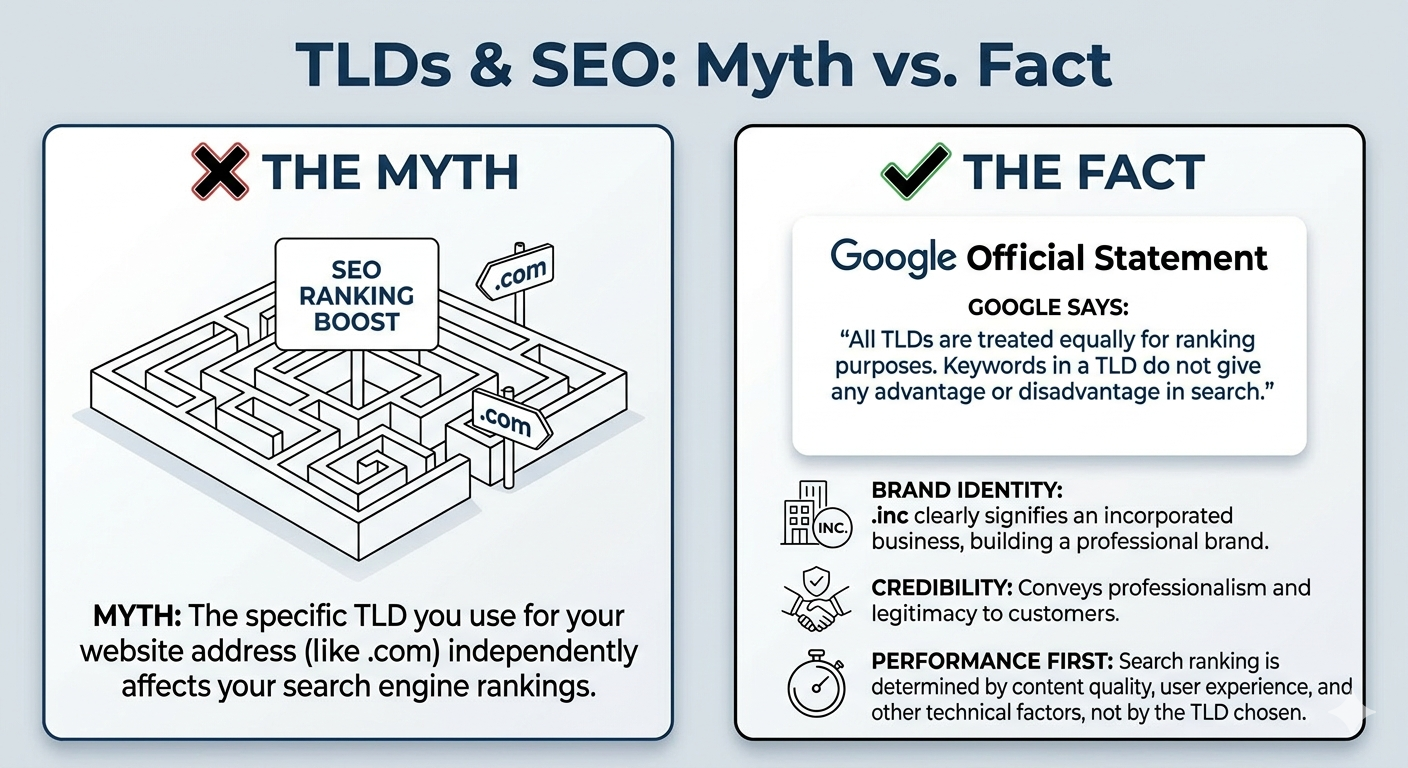
Our Rebuttal: That Myth Was Debunked by Google Over a Decade Ago.
A persistent fear, woven into the subtext of the Reddit thread, is that any domain other than .com is an SEO handicap.
Let's be blunt: This is factually wrong. And you don't have to take our word for it.
Google's own Search Central guidance, published to clarify this exact issue, states unequivocally:
“Overall, our systems treat new gTLDs like other gTLDs (like .com & .org). Keywords in a TLD do not give any advantage or disadvantage in search.” Source
It doesn't get clearer than that.
Still not convinced? Here is John Mueller, a Search Advocate at Google, on video stating that the newer top-level domains are "equivalent to other generic top-level domains like .com when it comes to SEO." Source
Our Takeaway: Your ranking is determined by the quality of your content, the authority of your backlinks, and the strength of your brand. Focus on building something worth ranking in the first place.
Reddit Objection #4: "What If I Change Names? There's No Resale Market."
Our Rebuttal: You're Thinking Like a Domain Reseller, Not a Company Builder.
The thread raises concerns about flexibility and resale value. “What if I pivot?” “Will I be able to sell it?”
These are common questions in conversations about domain names and long-term strategy.
When you acquire your company's core identity, the focus is on building the foundation that the business will grow on. The primary consideration becomes how well that identity supports the company over the long term.
Rather than focusing on resale value, it’s worth considering how the name will function as the core of your brand as the company grows.
If you’re still in the "experiment" phase, you can have it both ways. You can register a placeholder to test product-market fit while simultaneously reserving your .inc domain. This allows you to protect your "forever" name while you iterate, ensuring that when you're ready to flip the switch on your formal brand, the foundation is already there waiting for you.
Our Takeaway: Don't let a speculator's mindset infect a founder's decision. You're not buying a house to flip. You're pouring the foundation.
What Founders Say About Using a .inc Domain
Beyond theoretical debates about domains, it’s useful to look at how founders actually think about the decision. Here are a few examples from companies using .inc domains.
“As I just incorporated my company, I was looking for a domain that felt premium, credible, and aligned with our long-term vision… Using .inc doesn’t feel like a project—it actually shows seriousness about building a company and building a brand.”
- Sarang Prajapati, Founder
“We launched our business on collabcreators.com. Then we upgraded to collab.inc which is much shorter and matches our brand exactly. We're big fans of our domain.”
- James McFadden,Founder & Co-CEO
The Bottom Line
Reddit threads are useful for gathering opinions. But companies are not built on consensus from comment sections.
They’re built on decisions.
The domain you choose becomes the address on every contract, every investor email, every customer invoice, and every hiring offer. It’s the identity your company carries into every room long before you arrive.
Founders spend months refining their product, their pitch, and their strategy. The name they build all of it under deserves the same level of intention.
At my.inc, we believe founders should build on a foundation they plan to keep.
The real decision is simple: choose the identity you want your company to grow into, secure it early, and build from there.
Decide once. Build forever.
FAQ
1. Are .inc domains good for startups and businesses?
Yes, .inc domains are designed specifically for companies and founders who want a strong and professional brand identity. The extension signals that the business is incorporated and serious about building a long-term company. For startups working with investors, partners, and enterprise clients, a .inc domain can communicate authority and credibility from the start.
2. Should I buy a .inc domain for my company?
If you are building a long-term brand, the answer may be yes. Many founders ask, “should I buy a .inc domain?” when they cannot secure their ideal .com. Instead of choosing a complicated or temporary name, a .inc domain allows you to secure a clean and professional brand that you can grow into without needing to rebrand later.
3. Does a .inc domain affect SEO?
No. .inc domain SEO works the same as other generic top-level domains. According to Google, newer TLDs like .inc are treated the same as .com or .org in search rankings. Your SEO performance depends on factors like high-quality content, backlinks, and user experience, not the domain extension itself.
4. What is the difference between a .inc vs .com domain?
The main difference between a .inc vs .com domain is positioning and availability. .com is the traditional default used by millions of websites, while .inc is a more specialized extension built for businesses and incorporated companies. Because many .com names are already taken, .inc often gives founders access to shorter and cleaner brand names.
5. Why are .inc domains more expensive than other domains?
.inc domains are considered premium because they are positioned as long-term brand assets for companies. The higher price helps keep the namespace focused on serious businesses rather than mass speculation. Many founders see the cost as an investment that protects their brand identity and avoids the future cost of rebranding or changing domains.
6. From a technical standpoint, is there a difference between .inc and other domain endings?
No. .inc is ICANN-accredited and functions the same way as other popular domain endings such as .com, .net, and .org. From a technical and infrastructure perspective, there is no disadvantage when using a .inc domain compared to other domain extensions.
7. What should .inc domains be used for?
.inc domains can be used for many business purposes. Companies often use them for corporate websites, newsrooms, investor relations pages, employee portals, branded email addresses, and more.
My.inc helps founders, startups, and incorporated businesses establish credibility online with premium .inc domains, hassle-free setup, free custom email, and real human support. Built for brands that want to signal seriousness and permanence from day one, My.inc makes it easy to create a polished, professional online presence.